
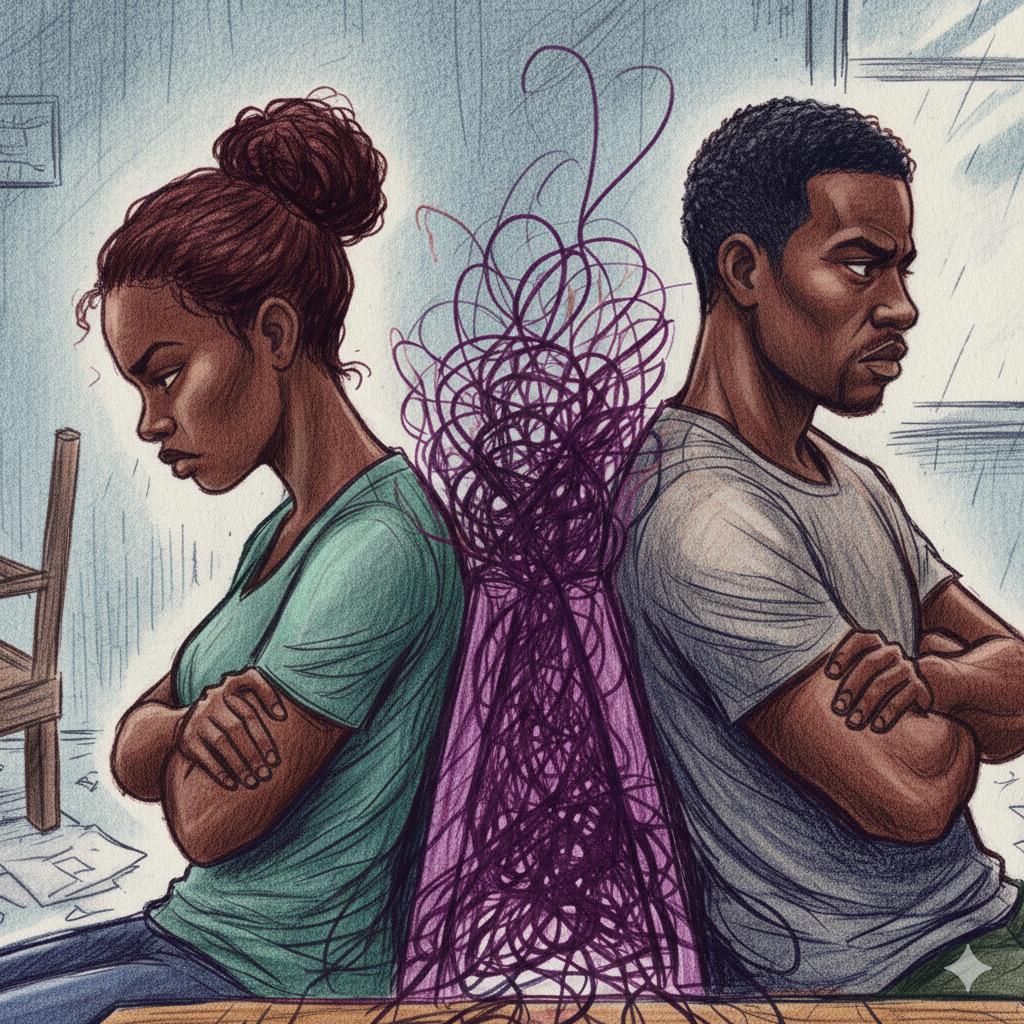
From Chats From the Peak with Dr. Lara and Memi
Welcome back, Peak Seekers! Whether you’re new here or you’ve been rocking with us from day one, we’re glad you pulled up a chair. If this is your first time tuning in, hit that subscribe button, drop a comment, and get comfortable—because on Chats From the Peak, we talk about marriage, healthy relationships, and love through a clinical lens, a cultural lens, and a whole lot of life experience.
Today we’re getting real about something that’s been a tale as old as time: why marriages fail.
Now, before we dive in, let’s be clear about what we’re NOT talking about. We’re not addressing the three A’s: abuse (physical, mental, financial—any kind), affairs/adultery, or abandonment. Those are always valid reasons to walk away, period.
What we ARE talking about are the practical, everyday reasons that—if left unchecked—can turn into those bigger issues. These are the seeds that, if you don’t pull them out at the root, will grow into weeds that choke out your marriage.
So let’s get into it. Here are five reasons why marriages fail—and more importantly, what you can do about it.
Reason #1: You’re Misaligned From the Start (And You Were Never on the Same Team)
This one hits hard for our singles and those still seeking marriage, because you still have time to get this right from the jump.
What this looks like:
- No shared goals or vision. One of you wants to be an astronaut, the other wants to stay grounded as an elementary school teacher. Unless there’s something connecting y’all—like a shared passion for community or service—how are you supposed to mesh those worlds?
- Being unequally yoked. This isn’t just about a Christian marrying a non-Christian (though that’s part of it). It’s about having fundamentally different beliefs and guiding principles. Maybe one of you grew up in a polygamous household and is open to that, while the other grew up in a monogamous home and absolutely is not. From the rip, y’all are unequally yoked.
Here’s the thing: These conversations need to happen BEFORE you say “I do.”
Don’t just assume y’all are on the same page because you vibe well or because your families love each other. You need to clearly discuss:
- What your goals are
- How you view child-rearing
- What your vision for family looks like
- Your beliefs about money, faith, gender roles, all of it
And listen—don’t go into marriage thinking, “I’ll change them.” That’s a trap. You need to ask yourself: If this person never changes, can I love them forever?
If the answer is no, run for the hills. Get a new family if you have to (we’re teasing… but seriously).
The Fix:
Get our conversation cards (shameless plug, but we mean it). Have the hard conversations NOW. Don’t wait until kids come or financial stress hits to realize y’all were never on the same team.
Reason #2: Unmet Expectations (The Silent Killer)
This one is sneaky. It’s the thing you don’t say out loud that slowly eats away at your connection.
What this looks like:
- “I thought we’d be living the lap of luxury by now.”
- “I didn’t think I’d have to do ALL the cooking.”
- “We’ve been married six years—I thought we’d be comfortable by now.”
- “She could pull her weight a little more.”
- “Why doesn’t he bring me flowers like that guy on Instagram?”
You’re thinking all of this… but you’re not SAYING it. And that’s the problem.
You’re sitting there with quiet disappointment, slowly picking away at your connection, waiting for your partner to read your mind. But here’s the truth: Your partner is not a mind reader.
You cannot expect them to just know that you want flowers on a random Thursday. You can’t expect them to know you’re frustrated about finances if you never open your mouth and say it.
The Fix:
Be vocal about your expectations.
Tell them:
- What your emotional needs are
- What romantic gestures matter to you
- What kind of lifestyle you want to build together
- What your dreams are
Even if it feels awkward. Even if you think it should be obvious. Say it anyway. Because unmet expectations that are never communicated? That’s the silent killer.
Reason #3: Conflict Without Care (Fighting to Win, Not to Heal)
Let’s be real: This is your spouse, not your opponent.
Y’all are on the same team. This is not WWE. You’re not The Rock and Stone Cold Steve Austin going head-to-head. You’re partners.
But so many couples approach conflict like it’s a courtroom battle. You’re keeping score. You’re trying to win. You’re bringing up old stuff just to prove a point.
What this looks like:
- “Well, let me tell you about the LAST time you tried that!”
- Going back and forth like: “You never listen to me!” “That’s not fair, I’m listening right now!” “See? You’re being defensive!” “I’m not defensive, YOU’RE attacking me!”
This is the loop. And you’ll stay stuck in it until you learn the exit.
When you’re fighting to win instead of fighting to heal, nobody’s winning. Your quarterback and wide receiver are beefing, so nobody’s scoring touchdowns. You’re both working harder, getting nowhere, and exhausting each other in the process.
The Fix:
Approach conflict like teammates solving a problem together.
Come to your partner like: “Hey, this is the issue I’m having. How do we fix this? How do we make this better for US?”
Stop gunslinging. Stop keeping tally. Stop trying to be right. Start trying to be connected.
Reason #4: Drifting Apart (Growing Separately Instead of Together)
Here’s the truth: You are not the same person you were when you first got married.
Life has happened. Careers have shifted. Kids came. Trauma happened. Wins and losses. You’ve changed—for better or worse—and so has your spouse.
The question is: Are you growing together, or are you growing apart?
What this looks like:
- “I don’t know who this person is anymore.”
- Feeling like strangers in the same house
- No curiosity about who your partner is becoming
- The friendship eroding
- Attraction fading
- Intimacy disappearing
When the friendship dies, the attraction goes. When the attraction goes, there’s no sex. And a marriage without sex? That’s a dying marriage.
The Fix:
Have curiosity about the new version of your partner.
Don’t expect them to be the same person they were at 25 when they’re now 35. Life has layered them. Get to know those layers.
Ask questions. Be vulnerable. Create space for your partner to evolve—and let them do the same for you.
Memi and I were talking the other night, and I said, “I’m just a different person now. The way I look at things has changed.” And instead of that being a problem, we leaned in. We talked about it. We learned something new about each other.
That’s what it looks like to grow together instead of apart.
Reason #5: Lack of Safety (When There’s No Refuge, Love Can’t Survive)
If your spouse is not your safe space, you’re in the danger zone.
Love cannot live where there’s no refuge. If you can’t be vulnerable with your partner—if you can’t share your fears, your dreams, your struggles—then intimacy is impossible.
What this looks like:
- You can’t express your needs without fear of judgment or attack
- You feel like you have to perform or be perfect
- You’re walking on eggshells
- You’re finding safety and vulnerability elsewhere (and that’s when affairs happen)
Sometimes that safety was never there. Sometimes it was there, but life happened and it eroded. Either way, without safety, your marriage is at risk.
The Fix:
Communicate that you don’t feel safe—and give your spouse the opportunity to repair it.
Don’t suffer in silence. Don’t just assume your partner knows. Say it:
- “I don’t feel safe sharing this with you, and I need that to change.”
- “I need to be able to be vulnerable without feeling attacked.”
And if you’re the one who’s made your spouse feel unsafe, own it. Apologize. Do the work to rebuild that trust.
The foundation of marriage is safety. Without it, everything else crumbles.
How to Fail-Proof Your Marriage
Alright, so we’ve talked about the five reasons marriages fail. Now let’s talk about how to combat them.
But first, a caveat: Everything we’re about to say requires TWO people willing to do the work. If one person is checked out, if one person is only showing up at 50% while the other is carrying 120%, these tips won’t be as helpful. Marriage requires both people to be all in.
If you’re in an extended period where your partner isn’t willing to fight for the marriage, that’s abandonment—and that’s one of the three A’s.
But if you’re both willing? Here’s how you fail-proof your marriage:
1. Stay Aligned
- Have regular check-ins about your goals (weekly, monthly, yearly)
- Find new hobbies together
- Create new memories—these are anchors for your relationship
- Do the things you did when you were dating (or create new versions of them)
Think of it like a car alignment. You hit potholes. Life throws bumps in the road. You get out of alignment. But you go to the shop, you get it fixed, and you keep moving forward together.
2. Communicate Your Expectations
- Tell your partner what you need emotionally, romantically, physically
- Don’t wait until you’re at a breaking point
- Be specific (not “I want more affection,” but “I need a 20-second hug every day”)
3. Fight Fair
- Remember you’re teammates, not opponents
- Approach conflict as a problem to solve together, not a battle to win
- Take breaks when things get heated
- Repair after arguments—don’t let wounds fester
4. Grow Together
- Be curious about who your partner is becoming
- Share what you’re learning about yourself
- Take on challenges as a team and learn from them together
- Prioritize intimacy—emotionally AND physically (yes, we’re talking about sex)
5. Create Safety
- Be vulnerable first
- Give your partner grace when they’re vulnerable with you
- Rebuild trust if it’s been broken
- Make your marriage a place where both of you can show up fully
The Bottom Line
Your marriage is worth fighting for.
The fact that you’re reading this right now tells us you’re not ready to give up. You’re looking for answers. You want better. You’re willing to show up.
And that—THAT—is where hope lives.
Your marriage didn’t get here overnight, and it won’t heal overnight either. But with intentionality, honesty, and the right tools, you can rebuild. You can reconnect. You can choose each other again.
Ready to Take the Next Step?
If you want practical tools to strengthen your communication and rebuild connection, check out our Finally Hear Each Other communication course. It’s designed specifically for couples who are ready to stop repeating the same patterns and start building the partnership they deserve.
And grab our 101 Chats to Reach the Peak Conversation Cards to spark real, intentional conversations that deepen trust and intimacy.
Join the Peak Seekers Community
Subscribe to Chats From the Peak wherever you listen to podcasts, and follow us on Instagram and TikTok @marriagepinnacle for daily inspiration, tools, and real talk.
Drop a comment and let us know: Which of these five reasons hit closest to home for you?
Your marriage is worth it. You’re worth it. Let’s reach the peak together.
– Dr. Lara & Memi
Marriage Pinnacle